Read more about the article Frequently Asked Questions
GDJ @ Pixabay, FAQ word made of question marks

Frequently Asked Questions

Ask 10 beekeepers and get 11 opinions Why are bees dying? Annual losses of entire honey bee colonies from the winter of 2006-2011 averaged about 33 percent each year, with a third of these losses attributed to Colony Collapse Disorder (CCD) by beekeepers. The winter of 2011-2012 was an exception, when total losses dropped to 22 percent. Can you imagine the uproar if dairy farmers or cattle ranchers began losing 22-33 percent of their livestock each year? Bees have been on this planet for about a 100 million years. Before 1980, honey bees in the US pretty much took care of themselves.…

Continue ReadingFrequently Asked Questions
Read more about the article Georgia Bee Laws
WilliamCho @ Pixabay, gold justice statue with blue sky background

Georgia Bee Laws

This information may change from time to time. Persons wanting to pursue the Georgia Bee Law more thoroughly can consult the following:Georgia Department of Agriculture honey bee web pageContact the Georgia Apiary Inspector, Mr. David Williams at David.Williams@agr.georgia.govCheck on your local county or city ordinancesIf you live in a neighborhood with a Home Owners Association, review your covenants, conditions, and restrictionsConsult an attorney.The following information is courtesy of the Georgia Department of Agriculture website. 2-14-40. License required for sale of bees; fee; revocation of license.(a) All persons, firms, or corporations desiring to carry on as a business the sale of bees,…

Continue ReadingGeorgia Bee Laws
Read more about the article Honey Bee Safety
Waugsberg @ CreativeCommonLicense

Honey Bee Safety

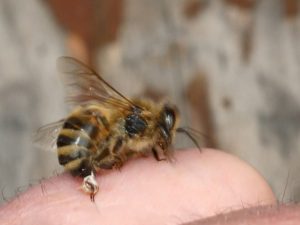
Ouch! I got stung. What should I do? First figure out if it was a bee or a wasp. Wasps have smooth stingers and they can sting multiple times.Female honey bees or workers have barbed stingers. When they sting, they leave the stinger in your skin with a venom sack and a muscle that continues to pump venom from the sack into your body. The quicker you remove the stinger, the less your reaction will be. It may be a small consolation but a worker bee sacrifices herself when she leaves a stinger in your skin.As an aside, when your…

Continue ReadingHoney Bee Safety
Read more about the article About Honey Bee Swarms
balouriarajesh @ Pixabay, bee swarm in tree

About Honey Bee Swarms

Honey bees are the only type of bee that swarms. It is a reproductive strategy of the bees, creating two or more new colonies from the original one. Swarming occurs mostly in the spring to enable the newly established colony sufficient time to gather sufficient food (nectar/honey) to survive the coming winter. The swarmed bees form a temporary cluster or bivouac prior to moving into more permanent housing. While the bees bivouac, scout bees are searching the area looking for an optimal new home. Thomas Seeley's book Honey Bee Democracy tells the fascinating story of how he determined what a honey bee's…

Continue ReadingAbout Honey Bee Swarms

Don’t hurt that swarm!

If you think you may have a swarm of honey bees, do not molest the swarm or kill them. Honey bees are the state insect of Georgia and are protected by law in the State of Georgia. You may decide to do nothing if you have a swarm. As a rule, the swarm will identify a new nesting site on its own and will move to it within twenty-four hours. However, having the swarm removed by a MABA member is preferred because: The honey bee colony is less likely to end up making their home in somebody's house The colony is more…

Continue ReadingDon’t hurt that swarm!
Read more about the article Want to be a Swarm Chaser in 2026?
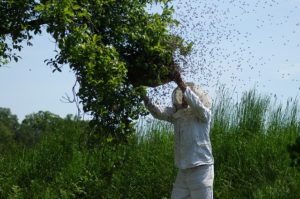
maria-anne @ Pixabay, beekeeper catching swarm on tree branch

Want to be a Swarm Chaser in 2026?

MABA members can simply request to be added to the club's swarm list. You will indicate how high you are willing to climb to retrieve a swarm and where you live. The swarm list manager will make the call based on queue order, location, and preferences.Swarm calls come in at all hours. If you are on the swarm list, you may be called at any time.Being on the swarm list does not guarantee that you will receive a call - swarm seasons can vary greatly.Those on the MABA swarm list must be current members, have the equipment necessary to retrieve a swarm…

Continue ReadingWant to be a Swarm Chaser in 2026?
Read more about the article Zika and Pesticides
image4you @ Pixabay, honey bee face, black background

Zika and Pesticides

Honey bees are collateral damage in the war on Zika. Bee kills from pesticide treatments are not new. What is new is a rational fear of the Zika virus and the rapid growth in commercial mosquito abatement franchises that feed on that fear. Many of these companies spray and fog at all hours of the day, in all wind conditions, and use pesticides that are highly toxic to honey bees and other beneficial insects and aquatic life.To reverse this trend, beekeepers need to communicate to neighbors and elected representatives that there are better ways to fight Zika than the scorched…

Continue ReadingZika and Pesticides